Summary
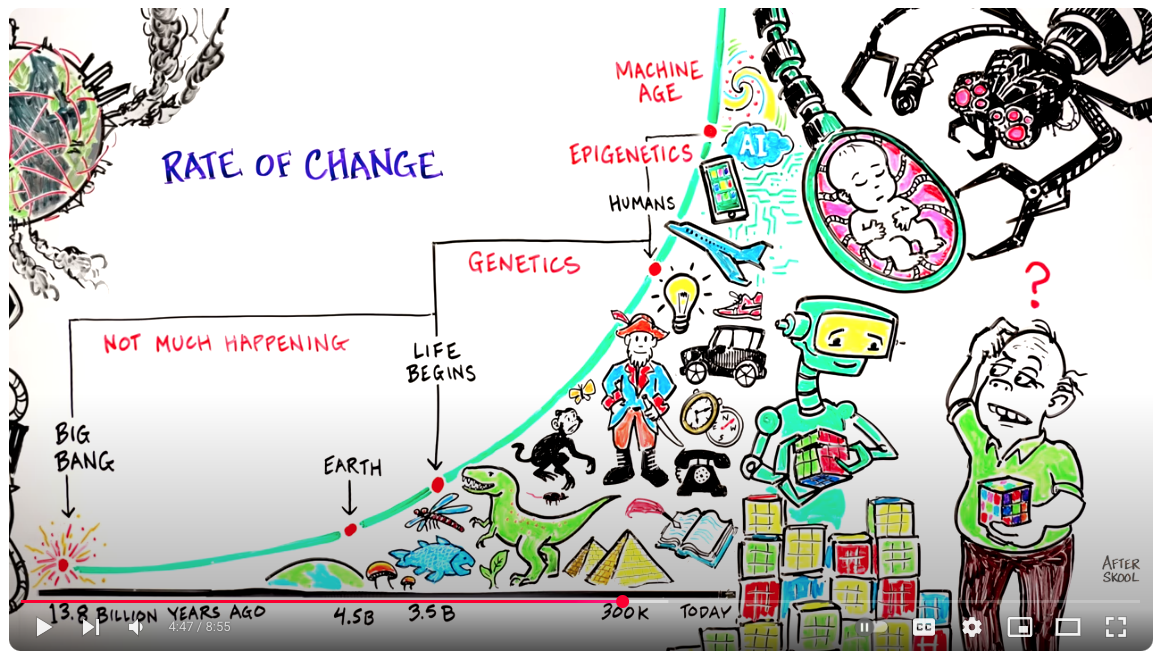
This video explores a fascinating concept of time as fundamentally tied to events and changes occurring within it, rather than as a constant, linear flow. The speaker argues that in the early universe, time moved extremely slowly because there were very few events or changes happening. As complexity and connectivity increase—through the emergence of atoms, chemistry, life, ecosystems, and eventually human culture and technology—time effectively accelerates, driven by the density of happenings within it. The shift from genetic evolution, which is slow, to epigenetic evolution, facilitated by human language and culture, marked a major acceleration in change. Now, we stand on the brink of another leap with the advent of human-machine symbiosis, where machines process information vastly faster than humans. This escalating complexity and speed of connectivity point toward a future singularity or “Omega Point,” a transformative event where change becomes overwhelmingly rapid and all-encompassing. This concept aligns intriguingly with other historical and cultural predictions, such as those of the Mayan calendar, which suggests a significant transformational event around 2012 (which didn’t work out). Whether this transformation happens precisely then or later, it is clear that humanity is approaching a pivotal moment of profound change, reshaping our species, technologies, religions, and society in unprecedented ways.
Highlights
- ⏳ Time is experienced only through events; the early universe saw very slow passage of time due to minimal activity.
- 🌌 Increasing complexity and connectivity in the universe have accelerated the effective speed of time.
- 🧬 Transition from slow genetic evolution to rapid epigenetic change via human culture and language drastically sped up change.
- 🤖 Human-machine symbiosis represents the next leap, with machines accelerating information processing beyond human capability.
- 🔮 The concept of the “Omega Point” or a transformative singularity marks a future where change becomes overwhelmingly rapid.
- 📜 The Mayan calendar’s predicted transformative event aligns with the speaker’s mathematical models of accelerating time.
- 🌍 Humanity is on the cusp of an unprecedented transformation affecting all aspects of life, society, and existence.
Key Insights
- ⏳ Time as Event-Dependent: The idea that time only “exists” or is “experienced” where change or events occur challenges the classical concept of time as a uniform, constant flow. This redefinition frames time as intrinsically linked to complexity and activity, providing a fresh lens to understand cosmological and evolutionary processes. The early universe’s near-absence of change meant time was effectively “slow,” highlighting the deep connection between physical phenomena and temporal experience.
- 🌐 Acceleration Through Complexity: As physical and energetic domains grow more interconnected and complex, the rate of change accelerates. This is evident in the emergence of atomic structures, chemistry, life, ecosystems, and cultural systems. The exponential increase in interrelations means more events happen in shorter time spans, effectively compressing historical epochs and making modern times feel increasingly fast-paced.
- 🧬 Epigenetic Evolution as a Game-Changer: The transition from genetic to epigenetic evolution—where change is driven by culture, language, and learned behavior rather than slow DNA mutations—marks a profound acceleration in human history. This shift allowed rapid adaptation and innovation, fundamentally reshaping societies at a speed unimaginable in purely biological evolutionary terms.
- 🤖 Human-Machine Symbiosis and Future Acceleration: The arrival of machines capable of processing information and making connections thousands of times faster than humans introduces a new phase of acceleration. This symbiosis could exponentially increase our capacity for complexity, knowledge, and change, potentially leading to a technological singularity where growth and transformation become self-perpetuating and overwhelming.
- 🔮 Omega Point and the End of History: The speaker’s concept of the Omega Point—a transcendental event where time and change accelerate to a singularity—echoes philosophical and scientific ideas about the ultimate fate of the universe and human civilization. This event is posited as imminent on a cosmic scale, marking a qualitative break in history and existence.
- 📜 Cultural Resonance with the Mayan Calendar: The alignment of the speaker’s mathematical predictions with the Mayan calendar’s end-date lends a fascinating cross-cultural validation of the idea that humanity is approaching a moment of profound transformation. This convergence suggests that disparate human cultures may intuitively sense and encode this acceleration and culmination of change, reinforcing the theory’s relevance.
- 🌍 Implications for Humanity: The near-future transformation implied by these accelerating processes will redefine human identity, society, technology, and spirituality. We stand at a critical juncture where the cumulative effects of millennia of development coalesce into rapid, unpredictable change. Recognizing and understanding this acceleration is crucial for navigating the challenges and opportunities of the coming era.
This exploration offers a comprehensive framework for interpreting time, change, and human evolution as part of a grand cosmic acceleration toward a transformative singularity. It invites us to rethink our relationship with time, technology, and the future of humanity itself.